Dependency Injection from First Principles
What is a dependency? What goes wrong when you manage them yourself? How does Dependency Injection fix it — and what are the three ways to do it in Spring?
#What Is a Dependency?
Before we can talk about injecting dependencies, we need to be precise about what a dependency actually is.
A dependency is any object that another object needs to do its job.
If UserService queries the database via a UserRepository, then UserRepository is a dependency of UserService. UserService cannot function without it.
public class UserService {
    // UserService depends on UserRepository
    private UserRepository repository;

    public User findById(Long id) {
        return repository.findById(id);  // can't work without repository
    }
}
This is unavoidable. In any non-trivial application, objects depend on other objects. The question isn't whether you have dependencies — you always will. The question is: who is responsible for creating and providing them?
#The Naive Approach: Creating Your Own Dependencies
The most obvious answer: the object creates its own dependencies.
public class UserService {
    private UserRepository repository;

    public UserService() {
        this.repository = new UserRepository();  // I'll make my own
    }

    public User findById(Long id) {
        return repository.findById(id);
    }
}
This compiles. This runs. In a small, throwaway program, this is fine.
But in a real application, this pattern causes three serious problems.
#Problem 1: Tight Coupling
When UserService does new UserRepository(), it hard-codes a specific class. It is now tightly coupled to that exact implementation.
What happens when requirements change — and they always change?
Scenario A: You want to add a caching layer. Instead of always going to the database, you want to first check Redis.
With tight coupling, you have to change UserService:
// Before
this.repository = new UserRepository();

// After — UserService now knows about caching details
this.repository = new CachedUserRepository(new RedisCache(), new UserRepository());
UserService is a business logic class. It should know nothing about caching infrastructure. But now it does.
Scenario B: You have 15 services all doing new UserRepository(). You need to switch from PostgreSQL to MySQL. You change UserRepository's constructor — and now all 15 services have to be updated.
Tight coupling means a change in one place ripples across the entire codebase.
#Problem 2: Hidden Dependencies
When you new up your own dependencies inside a constructor, those dependencies are invisible from the outside.
public class OrderService {
    private UserService userService;
    private PaymentGateway paymentGateway;
    private EmailService emailService;
    private AuditLogger auditLogger;

    public OrderService() {
        this.userService = new UserService();          // hides: UserRepository, DataSource
        this.paymentGateway = new StripeGateway();    // hides: API keys, HTTP client
        this.emailService = new SmtpEmailService();   // hides: SMTP config, MailSender
        this.auditLogger = new DatabaseAuditLogger(); // hides: another DataSource
    }
}
From the outside, OrderService looks simple. In reality, it secretly creates an entire object graph — database connections, HTTP clients, SMTP configurations, all buried inside nested constructors.
This is called the "hidden dependency problem". You cannot tell what a class truly depends on without reading its implementation. The complexity is invisible.
#Problem 3: Untestability
This is the most immediately painful consequence, and it's what drove the Spring team most.
Suppose you want to test UserService.findById(). With tight coupling:
public class UserService {
    private UserRepository repository;

    public UserService() {
        this.repository = new UserRepository(); // connects to real database
    }
}
When you instantiate UserService in a test, it immediately tries to connect to a real database. No database running in your test environment? The test fails to even instantiate the class. Test fails before it begins.
And even if the database is available — now your test depends on the database having specific data in it. Your test results become tied to database state. Tests affect each other. The order in which tests run matters. Tests that pass locally fail in CI. Tests that passed yesterday fail today because someone changed the data.
This is a fundamentally broken testing story.
#The Solution: Don't Create Your Dependencies — Receive Them
Here's the core insight of Dependency Injection:
A class should not be responsible for creating its own dependencies. It should declare what it needs and receive them from the outside.
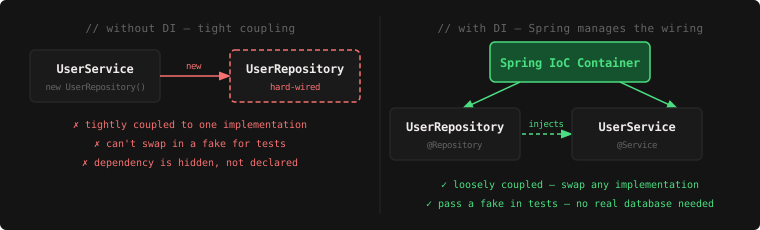
Applied to UserService:
public class UserService {
    private final UserRepository repository;

    public UserService(UserRepository repository) {  // receives it, doesn't create it
        this.repository = repository;
    }

    public User findById(Long id) {
        return repository.findById(id);
    }
}
Now UserService doesn't know how UserRepository is created. It doesn't know if it talks to PostgreSQL, MySQL, or an in-memory map. It just knows: I have a UserRepository and I can call findById on it.
The responsibility for creating and providing UserRepository has been moved out of UserService and into the caller.
#How This Fixes All Three Problems
Tight coupling — fixed.
If you want to swap UserRepository for CachedUserRepository:
// The caller (not UserService) makes the decision
UserRepository repo = new CachedUserRepository(new RedisCache(), new UserRepository());
UserService service = new UserService(repo);
UserService is untouched. It doesn't know — or care — what kind of UserRepository it received.
Hidden dependencies — fixed.
public UserService(UserRepository repository) { ... }The constructor signature is a complete, honest declaration of what UserService needs. You don't have to read the implementation. The contract is in the signature.
Untestability — fixed.
In a test, you can pass a fake UserRepository that doesn't touch a database at all:
class FakeUserRepository implements UserRepository {
    @Override
    public User findById(Long id) {
        return new User(id, "Test User"); // returns hardcoded data
    }
}

@Test
void testFindById() {
    UserRepository fakeRepo = new FakeUserRepository();
    UserService service = new UserService(fakeRepo); // no database needed

    User result = service.findById(1L);
    assertEquals("Test User", result.getName()); // passes every time
}
No database. No external services. No flaky tests. UserService can be tested in complete isolation.
#The Three Forms of Dependency Injection
There are three ways to inject a dependency. Each has trade-offs.
#1. Constructor Injection ✅ (Preferred)
The dependency is provided through the constructor.
@Service
public class UserService {
    private final UserRepository repository;

    public UserService(UserRepository repository) {
        this.repository = repository;
    }
}
Why this is the best choice:
- Dependencies are clearly declared in the constructor signature — impossible to miss
- The field can be
final— once set, it cannot be changed. This is a strong guarantee - The object is always fully initialised after construction — there is no state where
repositoryis null - Easiest to test — just call the constructor directly with a fake dependency
As of Spring 4.3, if your class has exactly one constructor, Spring injects it automatically — no @Autowired annotation required.
#2. Setter Injection
The dependency is provided through a setter method.
@Service
public class UserService {
    private UserRepository repository;

    @Autowired
    public void setUserRepository(UserRepository repository) {
        this.repository = repository;
    }
}
When to use it:
- Optional dependencies — the class can function with or without this dependency
- Dependencies that need to change after construction (rare)
The problem:
- The field cannot be
final - An object can exist in an incomplete state — if someone forgets to call the setter,
repositoryis null - Null pointer exceptions waiting to happen
#3. Field Injection ⚠️ (Avoid)
The dependency is injected directly into the field via reflection.
@Service
public class UserService {
    @Autowired
    private UserRepository repository;  // Spring injects this directly
}
You'll see this everywhere in tutorials, Stack Overflow answers, and legacy codebases. It looks clean. It feels easy. But it has significant problems:
- The field cannot be
final - Hidden dependencies — the constructor signature tells you nothing about what this class needs
- Impossible to test without a Spring context — you can't call a constructor and provide a fake, because there is no constructor that takes the dependency
- No way to see if you're violating the Single Responsibility Principle — a class with 8
@Autowiredfields is probably doing too much, but field injection makes it easy to keep adding fields without the pain that signals "this class is too big"
Spring itself recommends against field injection. Use constructor injection.
#Who Does the Injecting?
Right now, we've established what DI is. But who actually does the injecting?
In our examples above, we manually created dependencies and passed them in:
UserRepository repo = new UserRepository();
UserService service = new UserService(repo);
In a real application with hundreds of classes, each with multiple dependencies, manually wiring everything together is its own problem. You'd need one giant piece of code that creates every object in the right order and passes each one its dependencies.
This is exactly what Spring's IoC container does — automatically. You declare what each class needs (via constructor parameters). Spring builds the entire dependency graph, creates everything in the right order, and injects each dependency where it's needed.
That's the next lesson: Inversion of Control.
Key Takeaway: Dependency Injection is about honesty and decoupling. A class should declare its dependencies openly — in its constructor — rather than silently creating them. This makes the code testable, flexible, and maintainable. Constructor injection is the right default: dependencies are visible, the object is always complete, and testing requires nothing but a
newcall with fake dependencies.